OUR TECHNOLOGY
OUR TECHNOLOGY
Direct Private Signal.
It doesn't need your WiFi.
Direct Private Signal.
It doesn't need your WiFi.
Infant Optics monitors connect directly from camera to parent unit — no home network, no cloud, no subscription between them. It can't drop because your internet went down. It can't be interrupted by someone else streaming.
Infant Optics monitors connect directly from camera to parent unit. No home network, no cloud, no subscription between them. It can't drop because your internet went down. It can't be interrupted by someone else streaming.

WHY NOT WIFI?
WHY NOT WIFI?
Three reasons Infant Optics does not use WiFi
Three reasons Infant Optics does not use WiFi
Every monitor involves a transmission choice. WiFi is the more common path. It is also the more complex path. This is because WiFi introduces infrastructure that sits between the camera and the parent unit. Infant Optics chose the closed, private radio frequency instead. It all comes down to a single, simple principle:
Every monitor involves a transmission choice. WiFi is the more common path. It is also the more complex path. This is because WiFi introduces infrastructure that sits between the camera and the parent unit. Infant Optics chose the closed, private radio frequency instead. It all comes down to a single, simple principle:
The path between camera and parent unit should be as direct and secure as possible.
The path between camera and parent unit should be as direct and secure as possible.
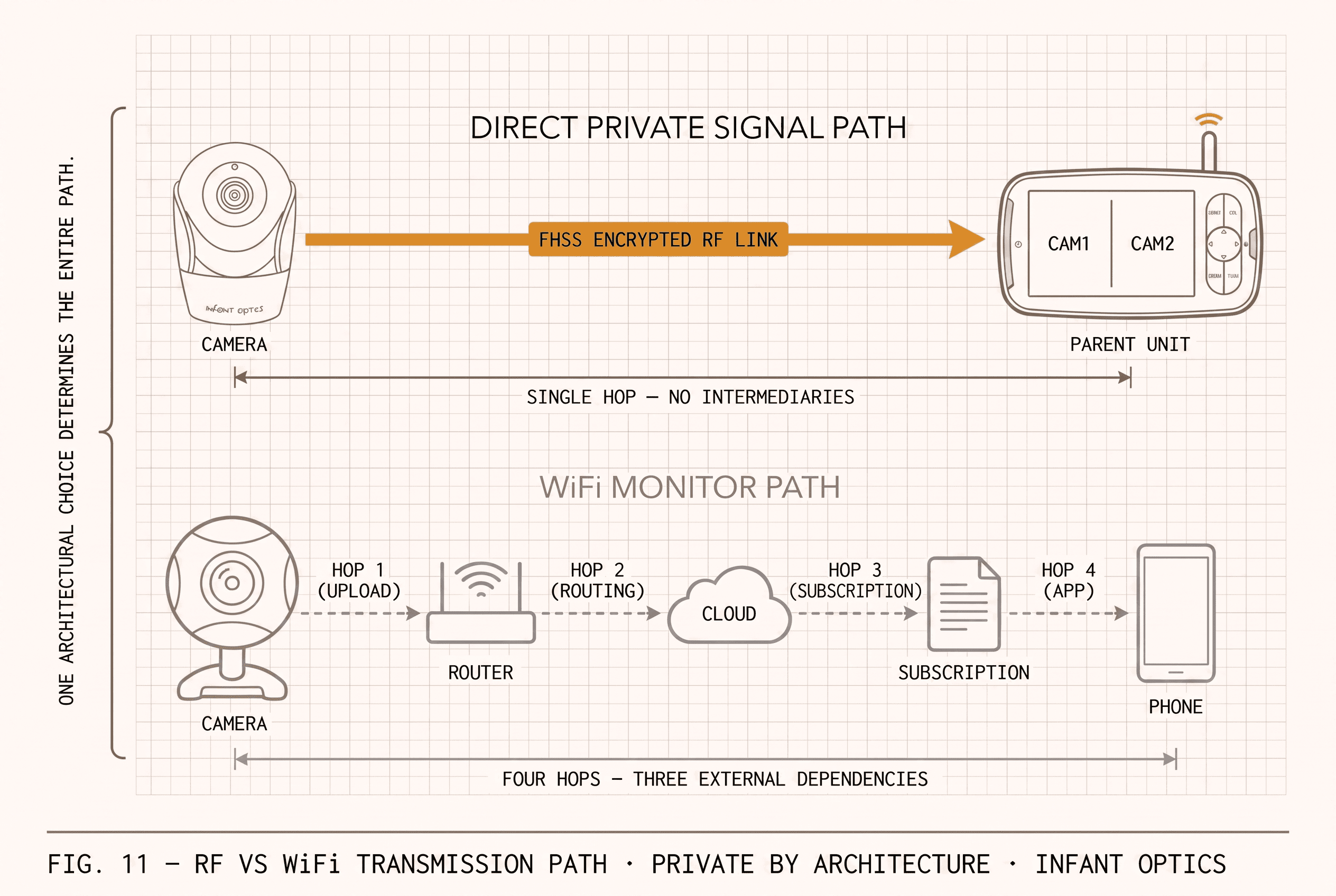
WIFI ROUTING
Routes video through external infrastructure
A WiFi camera sends video to your router. From there it may go to the cloud, through a subscription service, back to your phone. Four hops instead of one. Each hop is a point of potential failure, latency, or third-party access.
WIFI DEPENDENCY
Depends on your home network
If your router goes down, a WiFi monitor goes silent. If your internet provider has an outage, a WiFi monitor cannot stream to your phone. You are tied to the network it was set up on.
WIFI CONTENTION
Competes for a shared medium
Your home WiFi carries streaming, browsing, smart home devices, and neighbouring networks all competing for the same channels. When congestion rises, signal quality drops.
DIRECT PRIVATE SIGNAL
Keeps the signal contained
Direct Private Signals transmit directly from camera to parent unit. The signal never touches a router, never reaches the internet, and never requires a third-party service to function.
DIRECT PRIVATE SIGNAL
Own the connection
The camera and parent unit speak directly to each other. The only thing that can break the connection is distance or physical obstruction. Those are matters of engineering, not infrastructure.
DIRECT PRIVATE SIGNAL
Uses a dedicated link
Direct Private Signal uses a dedicated radio link with frequency-hopping technology that actively avoids interference, including WiFi itself. The monitor does not compete for bandwidth. It holds its own path.
WIFI ROUTING
Routes video through external infrastructure
A WiFi camera sends video to your router. From there it may go to the cloud, through a subscription service, back to your phone. Four hops instead of one. Each hop is a point of potential failure, latency, or third-party access.
DIRECT PRIVATE SIGNAL
Keeps the signal contained
Direct Private Signals transmit directly from camera to parent unit. The signal never touches a router, never reaches the internet, and never requires a third-party service to function.
WIFI DEPENDENCY
Depends on your home network
If your router goes down, a WiFi monitor goes silent. If your internet provider has an outage, a WiFi monitor cannot stream to your phone. You are tied to the network it was set up on.
DIRECT PRIVATE SIGNAL
Own the connection
The camera and parent unit speak directly to each other. The only thing that can break the connection is distance or physical obstruction. Those are matters of engineering, not infrastructure.
WIFI CONTENTION
Competes for a shared medium
Your home WiFi carries streaming, browsing, smart home devices, and neighbouring networks all competing for the same channels. When congestion rises, signal quality drops.
DIRECT PRIVATE SIGNAL
Uses a dedicated link
Direct Private Signal uses a dedicated radio link with frequency-hopping technology that actively avoids interference, including WiFi itself. The monitor does not compete for bandwidth. It holds its own path.
WIFI ROUTING
Routes video through external infrastructure
A WiFi camera sends video to your router. From there it may go to the cloud, through a subscription service, back to your phone. Four hops instead of one. Each hop is a point of potential failure, latency, or third-party access.
DIRECT PRIVATE SIGNAL
Keeps the signal contained
Direct Private Signals transmit directly from camera to parent unit. The signal never touches a router, never reaches the internet, and never requires a third-party service to function.
WIFI DEPENDENCY
Depends on your home network
If your router goes down, a WiFi monitor goes silent. If your internet provider has an outage, a WiFi monitor cannot stream to your phone. You are tied to the network it was set up on.
DIRECT PRIVATE SIGNAL
Own the connection
The camera and parent unit speak directly to each other. The only thing that can break the connection is distance or physical obstruction. Those are matters of engineering, not infrastructure.
WIFI CONTENTION
Competes for a shared medium
Your home WiFi carries streaming, browsing, smart home devices, and neighbouring networks all competing for the same channels. When congestion rises, signal quality drops.
DIRECT PRIVATE SIGNAL
Uses a dedicated link
Direct Private Signal uses a dedicated radio link with frequency-hopping technology that actively avoids interference, including WiFi itself. The monitor does not compete for bandwidth. It holds its own path.
WHAT IS FHSS?
WHAT IS FHSS?
Frequency-Hopping Spread Spectrum
Frequency-Hopping Spread Spectrum
A radio signal occupies a frequency, like a conversation on a specific channel. If two signals occupy the same frequency at the same time, they interfere. The simplest solution is to pick a quiet channel and stay there. That works until the channel becomes crowded.
Frequency-Hopping Spread Spectrum takes a different approach: instead of staying on one channel, the signal jumps across many channels in a rapid, pseudorandom sequence known only to the camera and the parent unit. The transmitter and receiver synchronize to this pattern, so the parent unit always knows which frequency the camera is using at any given millisecond, while any third-party receiver sees only noise.
A radio signal occupies a frequency, like a conversation on a specific channel. If two signals occupy the same frequency at the same time, they interfere. The simplest solution is to pick a quiet channel and stay there. That works until the channel becomes crowded.
Frequency-Hopping Spread Spectrum takes a different approach: instead of staying on one channel, the signal jumps across many channels in a rapid, pseudorandom sequence known only to the camera and the parent unit. The transmitter and receiver synchronize to this pattern, so the parent unit always knows which frequency the camera is using at any given millisecond, while any third-party receiver sees only noise.
First Generation FHSS
First Generation FHSS
First-generation FHSS, used in earlier wireless monitors, jumped across a limited set of channels within the 2.4 GHz bands. The hopping rate was measured in tens of hops per second. The channel set was narrow. It improved over fixed-frequency transmission, but interference was still possible when multiple devices overlapped within the hopping pattern.
First-generation FHSS, used in earlier wireless monitors, jumped across a limited set of channels within the 2.4 GHz bands. The hopping rate was measured in tens of hops per second. The channel set was narrow. It improved over fixed-frequency transmission, but interference was still possible when multiple devices overlapped within the hopping pattern.
Second Generation FHSS
Second Generation FHSS
(What Infant Optics baby monitors use)
(What Infant Optics baby monitors use)
The first generation proved the principle: moving across frequencies is more reliable than staying on one. Second-generation FHSS takes that same principle further, and improves upon the first-generation on every axis:
The first generation proved the principle: moving across frequencies is more reliable than staying on one. Second-generation FHSS takes that same principle further, and improves upon the first-generation on every axis:
Wider frequency coverage
The second generation spreads its hops across a broader spectrum range, reducing the probability that any single hop overlaps with interference.
Adaptive frequency agility
The system actively monitors the spectrum and identifies congested channels — including those occupied by WiFi — and excludes them from the hopping sequence. The monitor does not just jump randomly; it jumps intelligently.
The system actively monitors the spectrum and identifies congested channels — including those occupied by WiFi — and excludes them from the hopping sequence. The monitor does not just jump randomly; it jumps intelligently.
Faster hopping rate
Hundreds of hops per second, compared to tens in the first generation. The signal moves faster than any consumer interference source can track.
Improved error correction
Each hop carries redundant encoding. If a packet is lost on one frequency, the next hop on a different frequency carries enough information to reconstruct it. The parent unit never shows a blank screen from a single lost packet.
Wider frequency coverage
The second generation spreads its hops across a broader spectrum range, reducing the probability that any single hop overlaps with interference.
Faster hopping rate
Hundreds of hops per second, compared to tens in the first generation. The signal moves faster than any consumer interference source can track.
Adaptive frequency agility
The system actively monitors the spectrum and identifies congested channels — including those occupied by WiFi — and excludes them from the hopping sequence. The monitor does not just jump randomly; it jumps intelligently.
Improved error correction
Each hop carries redundant encoding. If a packet is lost on one frequency, the next hop on a different frequency carries enough information to reconstruct it. The parent unit never shows a blank screen from a single lost packet.
In practice: The monitor maintains a clear, stable video feed in environments where first-generation FHSS or fixed-frequency monitors would show interference, static, or dropped signal. The parent unit receives the video because the signal path adapts to the environment in real time.
In practice: The monitor maintains a clear, stable video feed in environments where first-generation FHSS or fixed-frequency monitors would show interference, static, or dropped signal. The parent unit receives the video because the signal path adapts to the environment in real time.
DIRECT PRIVATE VIDEO
DIRECT PRIVATE VIDEO
Private from the moment you open the box.
The video signal travels from the camera lens to the parent unit display along a single path. No router. No cloud server. No subscription service. No app required.
This is not a privacy mode or an optional setting. It is how the hardware is designed. The camera encodes the video, transmits it over the FHSS Radio Frequency link, and the parent unit decodes it. There is no IP address involved. There is no route to the internet.
The video signal travels from the camera lens to the parent unit display along a single path. No router. No cloud server. No subscription service. No app required.
This is not a privacy mode or an optional setting. It is how the hardware is designed. The camera encodes the video, transmits it over the FHSS RF link, and the parent unit decodes it. There is no IP address involved. There is no route to the internet. The signal is private by architecture, not by configuration.
What this means for you
What this means for you
No setup. Pair the camera and parent unit out of the box. No WiFi password, no app download, no account creation.
No subscription. The monitor works for as long as the hardware lasts. No monthly fee, no cloud storage plan, no tiered features.
No external dependency. Your internet provider can go down. Your router can fail. Your neighbour can saturate the WiFi band. The monitor continues to transmit because it does not rely on any of them.
No cloud vulnerability. There is no cloud service to breach, no account to compromise, no server between you and your child's room. The video exists only inside your home.
No setup. Pair the camera and parent unit out of the box. No WiFi password, no app download, no account creation.
No subscription. The monitor works for as long as the hardware lasts. No monthly fee, no cloud storage plan, no tiered features.
No external dependency. Your internet provider can go down. Your router can fail. Your neighbour can saturate the WiFi band. The monitor continues to transmit because it does not rely on any of them.
No cloud vulnerability. There is no cloud service to breach, no account to compromise, no server between you and your child's room. The video exists only inside your home.
SIGNAL RANGE
SIGNAL RANGE
Range that matches the home, not the router
Range that matches the home, not the router
WiFi range is determined by your router's power and antenna placement. The typical consumer router provides reliable coverage within about 150 feet indoors — and that assumes line of sight. Walls, floors, and appliances reduce it further.
Infant Optics monitors transmit in the 2.4 GHz frequency band, which penetrates walls, floors, and furniture significantly better than the 5 GHz band used by WiFi.
WiFi range is determined by your router's power and antenna placement. The typical consumer router provides reliable coverage within about 150 feet indoors — and that assumes line of sight. Walls, floors, and appliances reduce it further.
Infant Optics monitors transmit in the 2.4 GHz frequency band, which penetrates walls, floors, and furniture significantly better than the 5 GHz band used by WiFi.
Up to 1,000 feet of open-air range.
Up to 1,000 feet of open-air range.

OUR CORE VALUES
OUR CORE VALUES
We believe in safety, security and privacy first.
We believe in safety, security and privacy first.
Most consumer electronics companies use WiFi because it is cheaper, faster to develop, and lets them offer app features that look good on a box. The monitor becomes a peripheral in a larger ecosystem. It's one more device on your network, one more subscription in your monthly bill.
Infant Optics chose differently. Direct Private Signal monitors are more expensive to engineer and manufacture, and they do not support app features. It also produces a stable and secure connection that cannot be interrupted by anything. That trade-off was made deliberately, before the first circuit was laid down, and it has guided every product since.
The company has been answering the same question since 2011: what does it take to build technology a parent can actually trust? The answer, consistently, has been to remove dependencies rather than add them. No cloud server to maintain. No subscription model to justify. No app to keep updated. No WiFi standard to chase across generations.
Infant Optics monitors simply hold the connection it was designed to hold — directly, privately, for as long as the hardware lasts.
Most consumer electronics companies use WiFi because it is cheaper, faster to develop, and lets them offer app features that look good on a box. The monitor becomes a peripheral in a larger ecosystem. It's one more device on your network, one more subscription in your monthly bill.
Infant Optics chose differently. Direct Private Signal monitors are more expensive to engineer and manufacture, and they do not support app features. It also produces a stable and secure connection that cannot be interrupted by anything. That trade-off was made deliberately, before the first circuit was laid down, and it has guided every product since.
The company has been answering the same question since 2011: what does it take to build technology a parent can actually trust? The answer, consistently, has been to remove dependencies rather than add them. No cloud server to maintain. No subscription model to justify. No app to keep updated. No WiFi standard to chase across generations.
Infant Optics monitors simply hold the connection it was designed to hold — directly, privately, for as long as the hardware lasts.
You deserve real peace of mind. It is how the hardware works. There is nothing between you and your child's room.
You deserve real peace of mind. It is how the hardware works. There is nothing between you and your child's room.
FIND YOUR MONITOR
FIND YOUR MONITOR
All Infant Optics Baby Monitors share the same secure Direct Private Signal technology.
All Infant Optics Baby Monitors share the same secure Direct Private Signal technology.
Find out which one fits your current needs the best.
Find out which one fits your current needs the best.

